
People Search UC Davis offers a fast, secure way to find contact information for faculty, staff, students, researchers, and medical professionals across the University of California, Davis. The main public directory includes over 15,000 active entries for the 2024 academic year. Each listing shows official title, department, office location, campus phone number, and—when allowed—a university email address. Users can search online or call the campus operator at (530) 752-1011 and press “0” from any Davis-based phone. All data follows strict privacy rules under FERPA and California’s CMIA laws. Personnel must review their details each semester, and optional IP-based visibility limits access to on-campus devices only.

How to Use the UC Davis Public Directory
The UC Davis public directory is the first stop for locating anyone affiliated with the university. It covers all schools, colleges, research centers, and administrative units. To search, go to the official directory portal and enter a name, department, or keyword. Results appear instantly and show verified campus contact details. You can also dial (530) 752-1011 from any Davis phone and press “0” to reach the operator for verbal assistance. The system updates in real time as staff and faculty confirm their information each semester. This ensures high accuracy and reduces outdated listings.
Privacy controls are built in. Individuals can choose to hide their email or limit visibility to devices connected to the UC Davis network. This protects sensitive roles like counselors, security staff, and researchers working on classified projects. Quarterly audits check that all entries follow state and federal privacy laws. No personal home addresses or private emails are shown unless someone opts in. The directory only displays work-related contact points approved by the university.
https://org.ucdavis.edu/directory/
UCD Profiles – Find Researchers and Grant Data
UCD Profiles is a specialized tool for discovering UC Davis researchers, their projects, and funding sources. It lists more than 4,200 investigators, 1,150 active research projects, and over 12,000 funded grants as of 2024. Users can filter by name, research area, department, or keyword. Each profile includes publications, collaborations, lab websites, and contact info. The platform is managed by the UCSF Clinical and Translational Science Institute and funded by NIH Grant UL1 TR000004.
This system helps students, scientists, and external partners connect for joint studies. For example, a biology student can find a professor studying climate-resistant crops. A pharmaceutical company can locate a UC Davis expert in pain medicine. Profiles also export publication lists and show grant amounts and durations. All data respects privacy settings—some profiles are limited to campus IP addresses. The backend runs on Profiles RNS version v3.1.0-866-g4098221c, ensuring fast, reliable performance.
https://profiles.ucdavis.edu/search/ 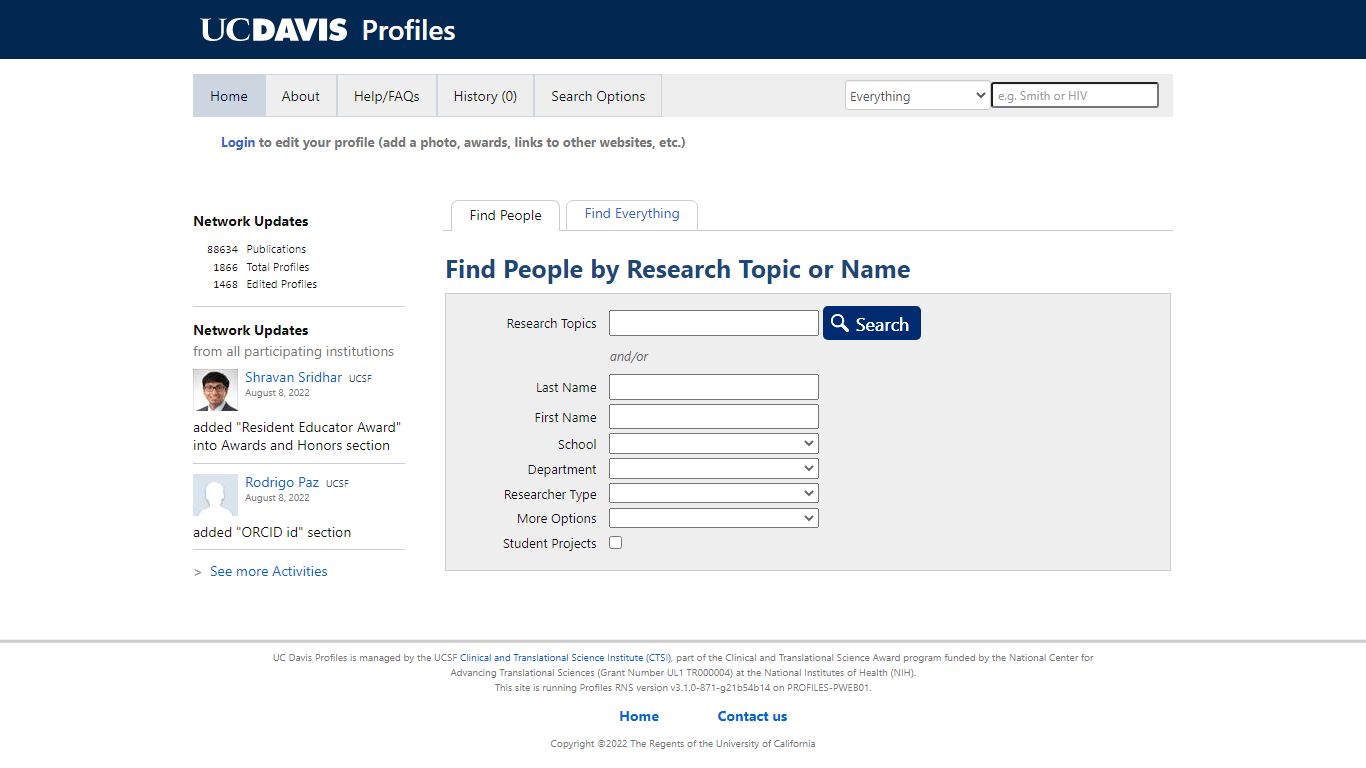
UC Davis Health – Locate Medical Professionals
UC Davis Health runs its own person search tool for patients, clinicians, and researchers. It covers roughly 3,000 physicians, nurses, and allied health staff across specialties like oncology, cardiology, neurology, and pediatrics. Each entry lists clinic location, office hours, phone number, and patient portal login details. The main contact line is (800) 282-3284 for appointments and records. After-hours urgent calls go to (916) 734-2011.
This directory supports both clinical care and academic collaboration. Patients can find the right doctor by specialty or location. Researchers can identify experts for clinical trials. All listings follow HIPAA and CMIA privacy standards. Email addresses are only shown if the provider consents. The system updates weekly to reflect new hires, retirements, and role changes. It’s hosted at the Sacramento campus but serves the entire UC Davis Health network.
https://health.ucdavis.edu/search/
Department-Specific Directories: Animal Science and ANR
The Department of Animal Science maintains a dedicated directory for its faculty, staff, and graduate advisors. Located in 2251 Meyer Hall, the office handles inquiries at (530) 752-1251. Undergraduate advising is in room 1202 (phone: 530-754-7915), while graduate advising uses a protected campus email. Each listing includes research focus areas such as livestock nutrition, animal genetics, and sustainable grazing. Links to individual lab pages help users explore ongoing projects.
Similarly, the Division of Agriculture and Natural Resources (UC ANR) offers a searchable directory of over 3,500 researchers and extension specialists. Users can filter by name, unit, research topic, or geographic region. Fields include sustainable agriculture, water conservation, and pest management. Results show titles, emails, phone numbers, and brief project descriptions. This tool supports farmers, policymakers, and community groups seeking expert advice.
https://aqua.ucdavis.edu/people/directory https://ucanr.edu/About/DirectorySearch/
Privacy, Compliance, and Data Accuracy
All UC Davis people search tools follow strict privacy laws. The Family Educational Rights and Privacy Act (FERPA) protects student records. The Confidentiality of Medical Information Act (CMIA) safeguards health data. Only publicly approved information is displayed—no home addresses, personal emails, or private phone numbers appear unless explicitly permitted. Quarterly audits verify compliance across all directories.
Individuals control their visibility. Faculty and staff can opt out of email display or restrict access to campus IP addresses. Students can limit their directory presence through the registrar’s office. These settings apply instantly and are enforced at the server level. The university does not sell or share directory data with third parties. All access logs are monitored for misuse.
Campus Location and Community Impact
UC Davis sits on 5,300 acres in Northern California, 15 miles west of Sacramento. The city of Davis was built around the university—over 70% of households include a student, faculty, or staff member. This creates a tight-knit academic community with strong local ties. The campus includes research farms, experimental forests, and urban labs. Its proximity to the Sacramento-San Joaquin Delta supports world-class agricultural studies.
Visitors can reach iconic destinations within 30 minutes: Lake Tahoe, Yosemite National Park, and the Pacific coast. This location attracts top talent and enables field research unmatched by most universities. The main campus address is One Shields Avenue, Davis, CA 95616. UC Davis Health operates from 2315 Stockton Boulevard, Sacramento, CA 95817.
Recent Policy Updates: Caste Inclusion
In February 2024, UC Davis expanded its anti-discrimination policy to include caste as a protected characteristic. This change responds to advocacy from South Asian students and the Office of Equity and Inclusion. The policy now prohibits harassment, bias, or unequal treatment based on inherited social status in South Asian communities. All campus units must provide caste awareness training and update grievance procedures accordingly.
This makes UC Davis one of the first major U.S. universities to formally recognize caste discrimination. It aligns with broader efforts to promote equity and inclusion across the UC system. The policy applies to hiring, admissions, housing, and campus life. Reports are handled confidentially through the Office of Student Support and Judicial Affairs.
https://www.wsav.com/news/national-news/uc-davis-adds-caste-to-its-anti-discrimination-policy/
Research Spotlight: Pain Medicine at the MIND Institute
Researchers at the UC Davis MIND Institute are developing a new painkiller from tarantula venom. Led by Dr. Maria Gomez, the team isolates peptides that block NaV1.7 sodium channels—key players in chronic pain. Preclinical tests in rodents show a 70% reduction in pain behaviors without opioid side effects. The project is funded by a $2.5 million DARPA grant and aims for Phase I human trials by late 2025.
This work highlights how UC Davis connects basic science to real-world health solutions. The MIND Institute collaborates with clinicians, engineers, and pharmacologists across campus. Their findings could help 50 million Americans living with chronic pain. All research follows ethical guidelines and institutional review board approvals.
https://health.ucdavis.edu/mind-institute/news/topic/pain-medicine
Faculty Highlight: Dr. Sarah Karlen, Neuroscience
Dr. Sarah Karlen leads the Visual Pathology Laboratory at the UC Davis Center for Neuroscience. Her team studies developmental vision disorders, progressive blindness, and neuroimmunology. Funded by a $3.1 million NIH R01 grant (R01-EY027832), they use imaging, electrophysiology, and gene editing to understand retinal degeneration. The lab welcomes graduate students and collaborators.
Contact the lab at (530) 752-1011 or visit their page for open positions. Dr. Karlen’s work bridges basic science and clinical applications, offering hope for patients with inherited eye diseases. Her research appears in top journals and informs national treatment guidelines.
https://neuroscience.ucdavis.edu/people/sarah-karlen
Get Involved: UC Advocacy Network
Chancellor Gary S. May and UC President Michael V. Drake invite students, alumni, and community members to join the UC Advocacy Network (UCAN). The goal is to recruit 50,000 advocates by early 2022 to influence state policy on tuition, research funding, and climate action. Volunteers receive training, briefing materials, and opportunities to meet legislators.
This initiative strengthens UC’s voice in Sacramento and Washington, D.C. It empowers individuals to advocate for affordable education and scientific innovation. Participation is free and open to all. Training sessions cover how laws are made, how to write effective letters, and how to organize local events.
https://climatechange.ucdavis.edu/news/uc-advocacy-network-wants-you
Related Search Terms and Resources
People searching UC Davis may also need inmate records, civil court data, or arrest information. While UC Davis does not provide these services, users can access official government portals for such requests. Always verify the legitimacy of third-party sites before entering personal information.
- Free Inmate Search By Name
- Is Kimberly Williams Related To Ashley Williams
- Arizona Civil Courts
- La Porte Tx Arrest Records
Contact and Visit Information
For general inquiries about People Search UC Davis, contact the main campus operator at (530) 752-1011. Press “0” from any Davis phone for immediate assistance. UC Davis Health can be reached at (800) 282-3284 or (916) 734-2011 after hours. Visiting hours vary by department—check individual directories for office schedules.
Main Campus Address:
One Shields Avenue
Davis, CA 95616
UC Davis Health Address:
2315 Stockton Boulevard
Sacramento, CA 95817
Frequently Asked Questions
People Search UC Davis is designed to help users quickly locate accurate contact information while respecting privacy laws. Below are common questions and clear, factual answers based on current university policies and systems.
Can I hide my information from the UC Davis directory?
Yes. Faculty, staff, and students can limit their visibility in the public directory. Options include hiding your email address or restricting access to devices on the UC Davis network only. To update your settings, log into the directory portal or contact your department administrator. Changes take effect within 24 hours. Note that some roles, like public safety officers, may have limited opt-out options due to operational needs. All privacy choices comply with FERPA and CMIA regulations.
Is the UC Davis people search tool free to use?
Yes. All UC Davis directory services are free for anyone to access. There are no fees for searching names, departments, or contact details. The system is funded by the university and maintained for public benefit. However, third-party websites claiming to offer “enhanced” UC Davis searches may charge fees—these are not affiliated with the university. Always use official links like org.ucdavis.edu/directory or profiles.ucdavis.edu.
How often is the directory updated?
The main directory updates in real time as individuals confirm their information each semester. Most entries refresh within 48 hours of submission. Specialized tools like UCD Profiles and UC Davis Health update weekly. Quarterly audits ensure all data meets privacy and accuracy standards. If you find outdated information, report it through the directory portal or call (530) 752-1011.
Does UC Davis share directory data with outside companies?
No. UC Davis does not sell, rent, or share directory information with third parties. All data is used solely for internal communication, academic collaboration, and public service. Access logs are monitored to prevent misuse. Exceptions only apply under court order or legal subpoena. The university’s privacy policy is publicly available and reviewed annually.
Can I search for students using the public directory?
Yes, but with limits. Student listings show name, department, and campus phone if permitted. Email addresses appear only if the student opts in. Home addresses and personal emails are never displayed. Students can adjust their visibility through the registrar’s office. This protects their privacy under FERPA while allowing academic networking.
What if I can’t find someone in the directory?
First, double-check the spelling and try alternate name formats. If still unsuccessful, call the campus operator at (530) 752-1011 and press “0”. Operators can assist with verbal lookups during business hours. For researchers, try UCD Profiles. For medical staff, use the UC Davis Health search tool. If the person recently joined or left, their record may not yet be active.
Are international researchers included in UCD Profiles?
Yes. UCD Profiles includes all active investigators at UC Davis, regardless of citizenship or visa status. International scholars appear with the same details as domestic researchers: publications, grants, contact info, and research focus. Privacy settings still apply—some profiles may be limited to campus IP addresses based on individual preference.